
From first meeting to portfolio inclusion
Insights from Martin Majdaniuk

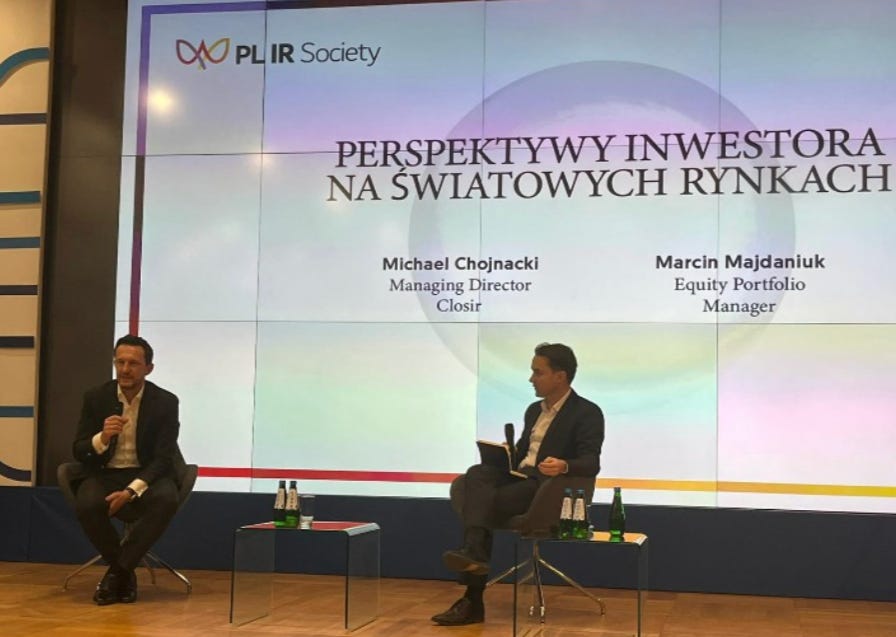
During the recent PL IR Society IR Day, I had the pleasure of interviewing Martin Majdaniuk, a highly experienced equity portfolio manager, well known across emerging markets, having previously managed funds at ADIA, Baring Asset Management and Nordea.
1/ Portfolio constraints silently dominate interest
A key point was about understanding fund constraints: geography, market cap, liquidity, and fund mandate. For seasoned investors, very few companies are truly “new.” Investment horizon matters as well; sovereign wealth funds, for example, typically have longer-term holding periods than most fund managers and no external clients.
IR implication: time is best spent on investors who can own the stock. IR teams should understand which investors are structurally constrained versus genuinely able to invest, and tailor outreach, expectations, and follow-ups accordingly.
2/ Idea generation is open, but inclusion is slow and collective
Within this defined universe, ideas can come from a variety of sources: conferences, reading, analysts. But moving from ticker to portfolio is often a multi-week or multi-month process involving analysts, PMs, and sometimes colleagues covering other sectors or regions.
IR implication: consistency matters more than first impressions. One good meeting rarely converts into an investment.
3/ Educating is one of the highest-value IR activities
Investors want to understand what a company actually does when the business or industry is complex, technical, or regulated.
IR implication: dedicate seperate sessions to investor education. Capital market days, factory deep dives, regulatory mechanics, and technology walkthroughs build long-term credibility far more than quarterly numbers.
4/ Crisis behaviour is the true IR differentiator
Periods of uncertainty or bad news are when investors pay the most attention to companies and their IR teams. Martin gave the example of Capitec in South Africa, which was hit by a short-seller report and a sharp share price fall. The company immediately reached out to its largest shareholders, organised direct calls with management and IR, addressed inaccuracies in detail, and clearly explained what was happening and why. Investors actually added to their positions, confidence was restored, and the stock recovered.
IR implication: investors get the clearest “taste” of IR quality during stress.
5/ Small and mid caps must focus on attention, not volume
Companies do not need massive budgets to reach investors, but do need a compelling story. Without one, more meetings simply amplify indifference.
IR implication: before spending resources on broad outreach, ask a hard question: what is genuinely special about our investment story?
6/ Knowing your buy-side audience
Buy-side analysts and portfolio managers come into meetings with different objectives. Analysts focus on detail and mechanics, whereas PMs focus on the big picture, risks, and conviction. This level of understanding often develops through pre-meeting dialogue.
IR implication: consider a two-deck approach: one simple, high-level deck for PMs, and a second, more detailed deck for analysts. This keeps meetings focused while serving both audiences properly.